Now you can build SimMotion models on the iPad using touch! Just touch the screen to create a particle, or drag your finger to define a rectangular body. To connect bodies with springs, dampers etc., simply touch a particle and drag your finger to the next particle. Simulations have never been so easy and fun. We hope you will enjoy the addition of touch input to web-based collaborative simulations. Let us know what you think.
Thursday, July 14, 2011
Tuesday, July 12, 2011
Matthew Peterson on interactive software designed for math learning
Excellent talk by Matt Peterson, founder of Mind Research, on how current teaching is flawed in its extreme emphasis on the use of words when clearly words do not work for most students.
Matt says: "...instead of just throwing a bunch of words at students, we create rich opportunities for them to create their own dots in their own heads, about how math works. And when students play an active role in figuring out how math works, they want to talk about it. It sparks mathematical talk. In this way, a language free approach can improve language skills."
Sunday, July 10, 2011
Have you heard about Gooru? Gooru is a platform for social learning, created by EdNovo.org. Gooru does an amazing job of allowing teachers to create ClassPlans - a wonderfully usable aggregation of various learning resources including textbooks from CK12 and other sources, videos, games and simulations. Gooru heavily uses all Google technologies including search, chat, voice and video calling, etc. Gooru is by far the best designed content aggregation platform that I have seen. Its current focus is k-12 and it is accessible to teachers by invitation only.
Kudos to the EdNovo team for realizing this tranformative platform, and all the best for future success!
Monday, June 27, 2011
Collaborative tinkering
Meriam-Webster defines tinkering as:
"to repair, adjust, or work with something in an unskilled or experimental manner"
Its what one of my younger brothers did during high school on the long summer afternoons when the rest of us took a nap. He pulled out all the broken old things like radios, etc and took them apart and tried to put them back together.
SimInsights is making simulation tools that enable virtual tinkering in collaboration with your friends. You can tinker with a model of a machine or circuit, then send a link to your friend so he or she can tinker with it. With tinkering comes experience which eventually helps build intuition and insights. Those insights differentiate a great scientist or engineer from a good one. Companies all around the world are tinkering with simulation tools to design better products in less time and with less money. Why shouldn't young people do the same?
Tuesday, June 21, 2011
Collaborative simulations in the browser: No installs, no plugins.
This post is inspired by a conversation I just had with an applicant. Even after visiting SimInsights website, he asked me if there really was no download-install required for using SimInsights software. Its striking how people are resigned to having to go through cumbersome processes to run a simulation.
Although web based simulations have been possible for many years, they have used flash or java plugins which have many issues. Most commonly, however, simulations have been done on the expensive desktops, using software products that can cost as much as $100,000 per user. This is rapidly changing, thanks to several technological advances. It is now possible to run very interesting simulations on your iphone, ipad, pc, mac or any other machine, by just logging into your SimInsights account. Visit www.siminsights.com to experience this flexibility. Just login using your gmail or yahoo account and get started building and sharing your simulations of electrical and mechanical simulations.
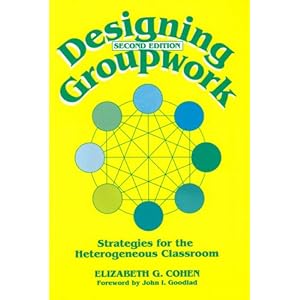
Designing group work: Strategies for the heterogeneous classroom
Thanks to Ajoy Vase, math teacher at Ouchi High School in Los Angeles, California, and graduate of Stanford STEP program for suggesting this wonderful book by Professor Elizabeth Cohen: Designing Groupwork: Strategies for the heterogeneous classroom.

The book is full of insights from social science research that inform the design of collaborative learning activities. One of the best blueprints for collaborative learning task design that I know of. Please share other books on the topic that you like.
There are many many insightful sentences that I want to share from this book. Here is one:
"The major advantage of combining a manipulative task with a group setting is that Geraldo has a number of helpful resources, including concrete materials to represent abstract ideas and other people engaged in the same task." (page 8)
I highly recommend this book to anyone interested in collaborative learning.
Monday, June 20, 2011
Excellent collection of simulations for teaching dynamics and controls
Thanks to Dr. Shivakumar I. Ranganathan of American University of Sharjah for pointing me to an excellent collection of java simulations for teaching dynamics and controls. See below a screenshot for a double pendulum simulation:
Click here for other models. You will need to install the Java plugin.
Friday, June 3, 2011
Rich assessments using simulations
Would it be useful to include an interactive simulation as part of an assessment of force and motion concepts?
Before you answer this question, take this survey and experience the difference. Here is a screenshot showing one of the questions:
Just in case any of the models looks empty, please move the mouse pointer inside the window to refresh. Note that if you are using a mac, you will only be able to see the first model and not the remaining two because of a known issue on mac for models with images.
Tuesday, May 31, 2011
Now you can see charts with your embedded simulations
We added charts in embedded simulations as shown below.
1. Select the Show Chart checkbox
2. Mouse over the Chart legend: text to get a drop down showing different signal options
3. Select the signals you want charted
A chart window will appear below the simulation.
1. Select the Show Chart checkbox
2. Mouse over the Chart legend: text to get a drop down showing different signal options
3. Select the signals you want charted
A chart window will appear below the simulation.
Saturday, May 28, 2011
Collaborative Simulations: Combining Science and Social Networking
Proud of the team of students at Heritage High School in Virginia, Ouchi High School in Los Angeles and Colts Neck High School in New Jersey who took on a biomechanics research problem and worked on using online collaboration tools. The biology team, led by Amol Patel, prepared the following presentation on muscle mechanics:
SimInsights Biology Team Presentation
The math team, led by Ajoy Vase, prepared the following video describing the math behind long jump:
The physics team, led by Joseph Santonacita, created the following four videos describing the force and motion concepts to their math and biology counterparts:
This multidisciplinary collaborative simulation project was conducted according to the Project Based Learning (PBL) framework. The teams used Google docs for collaborative document creation, Skype for teleconferencing and SimInsights for collaborative simulation, among others. The slides used for presentation at National Science Teachers Association (NSTA) conference in March 2011 in San Francisco are available here.
Angry birds simulation
It took less than a minute to make the following simulation resembling the Angry Bird game.
Give it a moment to load and then just move your mouse within the simulation window to refresh the model.Try turning on the velocity, acceleration and force vectors. Such visualizations can help kids appreciate abstract concepts.
Sunday, May 15, 2011
Nobel prize winning Physicist says "Lectures have been equally ineffective for centuries"
A study conducted by Physics nobelist Carl Weiman has found that clicker style teaching is more effective than traditional lecture style teaching. Here is an excerpt:
"The classes' test scores were nearly identical before the interactive sessions, but there was an obvious difference after the students took a 12-question quiz on what they were taught during the experimental week of instruction. Students in the interactive class got an average of 74 percent of the questions right, while those taught using traditional method scored only 41 percent."
Wednesday, May 4, 2011
Make your simulations come alive with images
You can now attach images to the bodies in your SimMotion2D model, making them come alive with meaning so that viewers can immediately understand what they represent. It can take a few moments to load, so please be patient, and remember to move your mouse within the window. The model below shows a shuttle, a tank and a car moving with constant speed. Gravity is turned off.
Subscribe to:
Posts (Atom)